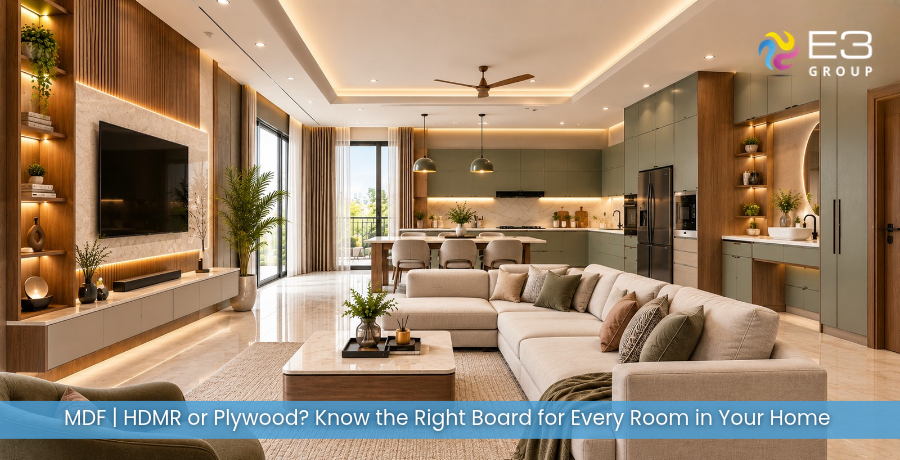
Choosing between MDF vs HDMR vs plywood is one of the first decisions you’ll make when planning new furniture, and it shapes how that furniture looks and lasts. MDF (medium-density fibreboard) is smooth and easy to shape. HDMR (high-density moisture-resistant board) is denser and handles humidity better. Plywood offers the most structural strength.
Getting this choice right matters. The wrong board can swell near a sink, sag under heavy books or leave you with a finish that never looks quite right.
There’s no single winner. The best board depends on the room, the moisture it faces, the strength it needs, how it will be used and the finish you want. In short: MDF suits dry, decorative work, HDMR Board suits kitchens and humid spaces, and plywood suits load-bearing furniture.
Which Board Is Best for Furniture?
It depends on where the furniture goes and what it has to carry.
- MDF → wall panels, decorative furniture, shutters and painted finishes in dry rooms.
- HDMR → kitchen cabinets, bathroom vanities, wardrobes and CNC-cut designs in humid areas.
- Plywood → beds, heavy shelving, study tables and any structure that carries weight.
MDF vs HDMR vs Plywood: What’s the Difference?
When you compare MDF vs HDMR vs plywood, all three are engineered boards, but they’re made differently, and that changes how they behave in your home.
What Is MDF?
Definition: MDF is made by breaking wood down into fine fibres, mixing them with resin and pressing them into flat, uniform sheets.
Key characteristics:
- Very smooth, even surface with no grain or knots
- Easy to cut, rout and carve
- Takes paint and laminate beautifully
- Weaker at the edges, where screws can loosen over time
- Swells if it stays wet
Common applications: wall panelling, cabinet shutters, decorative furniture, shelving in dry rooms and painted pieces.
What Is HDMR?
Definition: an HDMR board is a high-density fibreboard made with moisture-resistant resins and pressed at higher pressure than standard MDF, giving it a tighter, heavier core.
Key characteristics:-
- Denser and stronger than MDF
- Better resistance to humidity and occasional splashes
- Good screw-holding for a fibreboard
- Smooth surface, ideal for laminates and CNC routing
- Heavier than both MDF and plywood
Common applications: kitchen cabinets, bathroom vanities, wardrobes, CNC-designed panels and modular furniture.
A quick but important note: HDMR is moisture-resistant, not waterproof. Its edges still need proper sealing or edge banding.
What Is Plywood?
Definition: plywood is made by gluing minimum thickness sheets of wood veneer together.
Key characteristics:
- The strongest of the three for load-bearing work
- Excellent screw and nail holding
- Lighter than HDMR for the same thickness
- Available in grades, from interior use to boiling-water-proof (BWP) and marine
- Surface is less smooth, and edges show visible layers
Common applications: beds, heavy shelving, study tables, sink cabinets, carcasses and structural furniture frames.
Which Board Is Best for Each Room?
This is where the MDF vs HDMR vs plywood choice becomes practical. Each room puts different demands on your furniture.
Which Board is Best for Kitchen Cabinets?
For kitchen cabinets, HDMR board is a practical choice because kitchens often involve regular moisture exposure. Its strength suit cabinets, drawers and frequently used storage. Application areas where we can install HDMR boards include base cabinets, overhead units and modular kitchen furniture where durability and moisture resistance are important.
Which Board Is Best for Bathroom Cabinets?
Bathroom cabinets need materials that can handle high humidity and occasional water exposure. HDMR board is generally suitable because of its moisture-resistant properties. By using this board, you get dimensional stability, density, proper edge sealing and surface finishing, especially for vanities and bathroom storage units.
Which Board Is Best for Wardrobes?
Plywood works well for making wardrobes due to high durability and added strength. It is however important to consider the wardrobe’s weight and storage requirements while selecting plywood in the required thickness.
Which Board Is Best for Bedroom Furniture?
MDF is widely suited to bedroom furniture because it offers a smooth surface and flexibility for different designs. It works particularly well for bedside tables, dressing units and cabinets. HDMR can also be considered where greater strength or improved resistance to occasional moisture is required.
Which Board Is Best for Living Room Furniture?
MDF is a versatile option for TV units, storage units and decorative furniture because its smooth, uniform surface supports laminates, paint and detailed designs. HDMR is another useful choice for furniture requiring additional strength, helping create functional living-room pieces with a refined appearance.
Which Board Is Best for Study Tables?
Firstly, Load requirements and design need to calculated for fabricating durable study tables using HDMR or MDF. It is better to know MDF provides a smooth surface finish, while HDMR offers greater density for demanding applications. For everyday use, proper board thickness, edge finishing and sturdy construction are equally important for lasting performance.
Which Board Is Best for Wall Panels?
MDF is particularly suitable for wall panels and other decorative applications because of its smooth, consistent surface. It is also well suited to intricate CNC designs. Depending on the project’s finish requirements, MDF can accommodate paint, laminates, veneers and other decorative surface treatments effectively.
MDF vs HDMR: Which One Should You Choose?
Choose MDF for dry indoor furniture, decorative panels and applications that need a smooth, easy-to-finish surface. Choose HDMR where higher strength, density and moisture resistance are important. The right choice ultimately depends on the application, environment, finish and expected usage.
Is HDMR better than MDF?
A one word answer is ‘Yes’!
- Moisture: HDMR resists humidity far better. MDF should stay in dry rooms.
- Strength: HDMR’s higher density makes it stronger and better at holding screws.
- Finish: both are excellent. MDF is slightly easier to paint, while HDMR gives very crisp CNC edges.
- Applications: HDMR suits kitchens, bathrooms and wardrobes. MDF suits wall panels and decorative pieces.
- Cost considerations: MDF is usually cheaper, so it makes sense where moisture and heavy loads aren’t a concern.
HDMR vs Plywood: Which One Should You Choose?
Choose HDMR for furniture and interior applications that require a smooth finish, high density and good moisture resistance. Plywood is better suited where structural strength, screw-holding capacity and load-bearing performance are priorities. Your choice should depend on the application, moisture exposure, desired finish and overall project requirements.
Is HDMR better than plywood?
Not always. Each board wins in different situations. Here is the difference-
- Strength:- plywood is stronger for load-bearing.
- Moisture:- both perform well, but BWP and marine plywood handle direct water better than HDMR.
- Weight:- HDMR is heavier, which matters for tall shutters and wall-hung units.
- Workability: HDMR is easier to machine and gives smoother results with CNC and laminates.
- Applications: use HDMR for shutters, panels and modular cabinets. Use plywood for beds, heavy shelves and sink units.
How to Choose the Right Board: Quick Decision Guide
Still unsure? Use this guide to settle the MDF vs HDMR vs plywood question for your project.
| If you need | Consider | Why |
| Kitchen furniture | HDMR | Handles humidity and gives a smooth laminated finish |
| Sink or under-basin units | BWP plywood | Best protection against direct water |
| Decorative furniture | MDF | Smooth, easy to shape and cost-effective |
| Wall panels with CNC designs | MDF or HDMR | Clean cuts and a flawless painted or laminated finish |
| Wardrobe shutters | HDMR | Smooth finish with good screw holding |
| High-strength applications | Plywood | Carries heavy loads and long spans without sagging |
| Beds and study tables | Plywood | Strong, durable and built for daily use |
Final Takeaway
When comparing MDF vs HDMR vs plywood, the right choice depends on five things: the room, its moisture levels, the strength needed, the finish you want and how the furniture will be used.
MDF is ideal for dry rooms, decorative items and walls panels. HDMR is the dependable all-rounder for kitchens, bathrooms and wardrobes, combining moisture resistance with a premium surface. Plywood remains the strongest option for beds, study tables, heavy shelving and anywhere near direct water.
Many of the best-built homes use all three, each in the place it performs best. Match the board to the room, and your furniture will look better and last longer.
Planning new furniture or a kitchen? Contact our experts for choosing the right board for every room in your home.