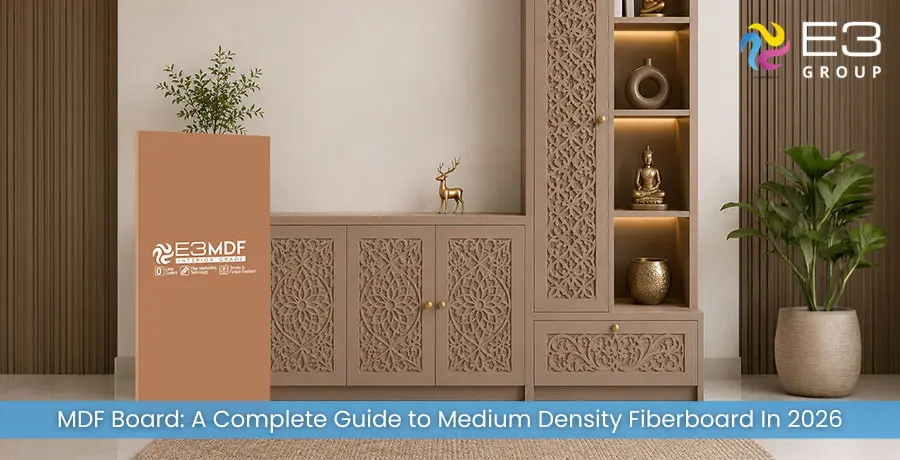
If you’ve ever walked into a well-finished office, a modular kitchen, or a boutique retail store, there’s a good chance the furniture and wall panelling around you were made from MDF board. Over my decade of experience specifying interior materials for residential and commercial projects, I have worked with dozens of manufacturers, compared hundreds of product samples, and supervised large-scale installations — and MDF remains one of the most versatile, cost-effective, and design-friendly panel materials available today.
In this guide, I’ll walk you through everything you need to know about E3 boards — what it is, how it’s made, the different types available, standard MDF sheet sizes, pricing, and how to choose the right product for your project.
What Is MDF Board and How Is It Made?
MDF, or medium-density fiberboard, is manufactured by refining hardwood or softwood residuals into uniform wood fibres, bonding them with wax and a synthetic resin, and pressing the blend into dense, homogeneous panels under controlled heat and pressure. Resulting in a smooth, dense, and uniform panel with no grain pattern — making it ideal for painting, laminating, and precision cutting.
Unlike solid wood, this board has no knots, voids, or directional grain. This consistency is what makes it the material of choice for cabinet makers, furniture designers, interior decorators, and architects around the world.
It’s worth clarifying a common misconception: high density fiberboard and MDF are not the same thing, even though the terms are often used interchangeably. HDF is denser, harder, and more wear-resistant than standard MDF. If your project involves flooring underlays or shelving that will bear significant loads or foot traffic, E3 high density fiberboard is the right call — not MDF.
Types of boards to choose right
Not all boards are created equal. Different applications demand different grades:
Standard MDF
The most widely used type for furniture, cabinets, shelving, and interior wall panelling. Available in a range of thicknesses and MDF sheet sizes, it accepts paints and laminates exceptionally well.
Moisture-Resistant
Specifically manufactured according to the latest engineering concepts to stop moisture from decaying your furniture and doors, making it ideal to use in the kitchen, bathroom, and other humidity-prone places of your house & office.
Fire-Retardant E3 MDF (FR MDF)
Treated with fire-retardant chemicals during manufacture. Required by building codes for use in commercial spaces, public buildings, and high-rise interiors.
Ultra-Light MDF
Engineered with a lower-density core while maintaining surface hardness. Reduces structural load in large furniture pieces — particularly useful for wardrobe shutters and ceiling panels.
E3 MDF: Smooth Finish & High Durability
MDF is specifically engineered to meet the most stringent formaldehyde emission standards. In indoor environments where air quality is a priority — hospitals, schools, childcare centres, and premium residences — certified panels deliver measurably lower formaldehyde emissions than standard grades. E3 compliance is increasingly being written into green building specifications (CARB and FSC) as occupant health awareness grows. When sourcing MDF for sensitive environments, always request an emission test certificate from your supplier.
Size Sheet: Helps to Find the Right MDF
Check the size table below and select the right board:
| Thickness | Standard Sheet Size | Common Applications |
| 2.5 mm | 8 ft × 4 ft | Backing panels, lightweight applications |
| 6 mm | 8 ft × 4 ft | Cabinet backs, decorative panels |
| 9 mm | 8 ft × 4 ft | Shelving, partitions |
| 12 mm | 8 ft × 4 ft | Furniture, wardrobe shutters |
| 18 mm | 8 ft × 4 ft | Heavy-duty shelving, countertops |
| 25 mm | 8 ft × 4 ft | Structural furniture, worktops |
Some manufacturers also offer jumbo sheets (9 ft × 4 ft or 8 ft × 6 ft) and custom-sized MDF sheet formats for large-scale commercial projects. Always confirm available MDF sheet sizes with your supplier before finalising your cutting plan.
MDF Board Price: Suits Budget of Every Home
MDF board price varies depending on thickness, grade, brand, and regional availability. Here is a general MDF price reference for the Indian market:
| Thickness | Grade | Approx. MDF Price (per sheet) |
| 6 mm | Standard | ₹500 – ₹700 |
| 9 mm | Standard | ₹700 – ₹950 |
| 12 mm | Standard | ₹900 – ₹1,200 |
| 18 mm | Standard | ₹1,200 – ₹1,700 |
| 18 mm | MR Grade | ₹1,500 – ₹2,100 |
| 18 mm | E3 / FR Grade | ₹2,000 – ₹2,800 |
MDF price figures are indicative and vary by brand, city, and order volume. Bulk purchases typically attract discounts of 10–20%.
Key Applications: Improve Aesthetics of Your Home
This board is found across virtually every segment of interior construction and furniture manufacturing:
- Modular kitchens — carcass panels, shutters, and drawer fronts
- Wardrobe and storage systems — shelves, partitions, and back panels
- Office furniture — desks, pedestals, and cable management panels
- Retail fixtures — display shelving, counters, and fascia panels
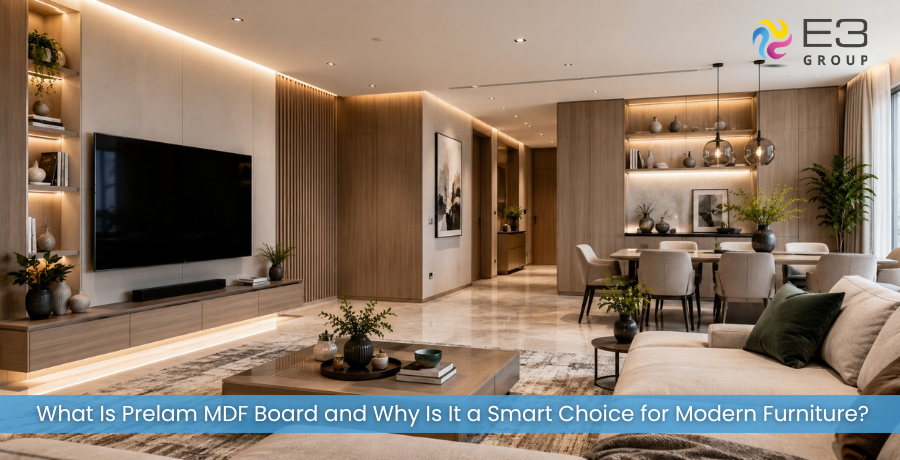
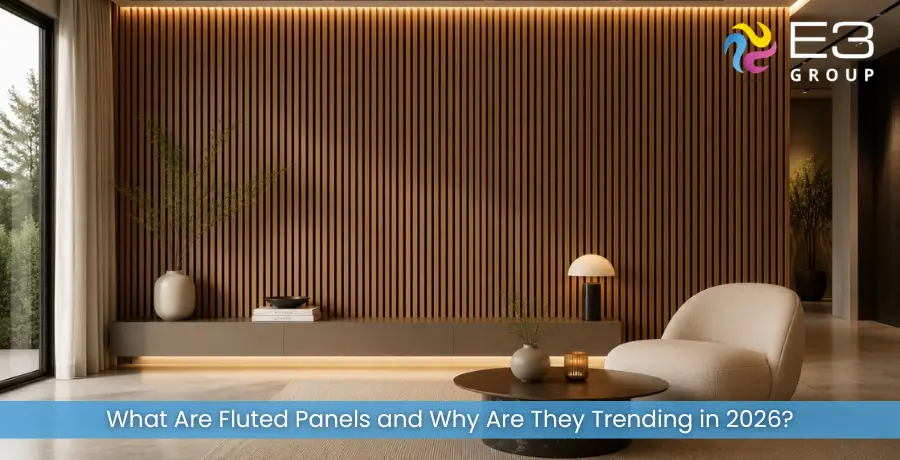
- Wall panelling — wainscoting, dado panels, and feature wall cladding
- Door skins — flat panel and moulded door faces
- Signage and display boards — routed lettering and 3D display elements
- Speaker cabinets and acoustic panels — the dense, non-resonant structure of board makes it acoustically superior to particleboard for this application
How to Choose a Board at the Right Medium Density Fiberboard Price?
Some common steps to select the right MDF Board:
Step 1 — Define the environment. Is the space dry, humid, or exposed to moisture? This determines whether you need standard, MR, or FR grade.
Step 2 — Set your emission requirement. For schools, hospitals, or LEED-certified projects, specify E3 grade from the outset. Don’t retrofit this decision later.
Step 3 — Confirm the MDF sheet sizes you need. Plan your cutting layout before ordering — a well-optimised cut plan can reduce waste by 15–25%.
Step 4 — Compare medium density fiberboard prices across certified suppliers. Request mill test certificates and verify thickness tolerances on sample sheets.
Step 5 — Check the surface finish. Premium MDF board has a smooth, sanded face that accepts laminate or paint without requiring excessive coats of sealer. Run your hand across the surface — it should feel uniform, with no pitting or fibre blowout.
Conclusion
Choosing the right MDF board comes down to matching the grade, thickness, and emission standard to your project’s real demands — not just the price tag. Whether you are specifying panels for a modular kitchen, a school interior, or a large-scale commercial fit-out, prioritising MDF ensures better indoor air quality, long-term durability, and compliance with green building standards. MDF continues to replace traditional plywood across Indian furniture and interior projects in 2026. E3 ensures you get consistent quality, transparent pricing, and panels built to perform for years to come.
FAQs: MDF Board
Q1. What is the difference between MDF board and particleboard?
MDF board and particleboard might look similar stacked in a warehouse, but they behave very differently once they’re in your project. MDF is made from fine wood fibres pressed together under high pressure, which gives it that smooth, dense surface that takes paint and laminate so cleanly. Particleboard, on the other hand, is made from coarser wood chips and sawdust—it’s lighter, yes, but also rougher, less dense, and noticeably weaker when it comes to holding screws. If you’re building furniture or cabinetry where the finish and longevity actually matter, MDF board is the one worth specifying.
Q2. What is the typical price of an 18 mm MDF sheet in India?
For a standard 18 mm MDF sheet (8 ft × 4 ft), the MDF board price in India typically ranges from ₹1,200 to ₹1,700 for standard grade, and ₹1,800 to ₹2,500 for moisture-resistant or E3-certified grades. The MDF price varies by brand, city, and order quantity—bulk buyers usually get 10–20% off.
Q3. Is MDF board waterproof?
Standard MDF board is not waterproof and will swell if exposed to moisture or water. For wet areas such as kitchens and bathrooms, specify Moisture-Resistant (MR) grade MDF, which uses water-repellent resins. Even MR MDF is moisture-resistant, not waterproof—exposed edges should always be sealed with edge banding or paint to prevent water ingress.
Q4. What does E3 mean in MDF, and why does it matter?
Formaldehyde off-gassing from wood panels is a genuine indoor air quality concern—and the E3 emission classification exists to tackle it head-on. E3 MDF board sits at the top of the safety tier, releasing the least formaldehyde of any classified panel. For schools, hospitals, homes, and any project chasing CARB and FSC certification, E3 isn’t just the smart choice—it’s fast becoming the only acceptable one.